Lean Six Sigma has been published on for thirty years and the bookshelf reflects it. Hundreds of titles, dozens of certification guides, half the airport business section. This is the shortlist of 10 Lean Six Sigma books worth the shelf space in 2026 — ranked by working utility, not by Amazon ranking. Field reference, certification prep, the Toyota foundations every Belt eventually re-reads, and a few outside-the-canon picks that reshape how you think about process work. All reviewed by someone who has actually used them on real projects.
How this list was put together
Three filters. First, the book has to be currently in print with an edition from 2018 or later (or a 40th-anniversary reissue, in the case of The Goal). Second, it has to get used after you finish it — either as desk reference, exam prep, or as a recurring re-read. The bookshelf in this office has 200+ quality and process titles; the list below is the ten that come off the shelf for actual project work, not the ten with the best reviews. Third, the set has to cover the LSS practitioner journey end to end: certification, deployment, daily practice, and the underlying thinking that holds the method together.
Format: each book gets a verdict line (best for / honest weakness), a substantive review, and a "where it earns its place" note. Page counts and edition notes are 2026-current. Amazon URLs are not included on this page yet — affiliate program activation is pending. When the links go live, they will appear with the same opinions you read here.
The 10 books at a glance
| # | Book | Author(s) | Best for | Pages |
|---|---|---|---|---|
| 1 | The Lean Six Sigma Pocket Toolbook | George, Rowlands, Price, Maxey | Desk reference, every working Belt | 240 |
| 2 | LSS Green Belt Study Guide 2026-2027 | Miles Jefferson | Active certification candidates | ~350 |
| 3 | Lean Six Sigma (combining quality + speed) | Michael L. George | LSS deployment leaders | 368 |
| 4 | The Six Sigma Way | Pande, Neuman, Cavanagh | Managers without engineering background | 448 |
| 5 | The Toyota Way (2nd Edition) | Jeffrey K. Liker | Lean foundations, every Belt eventually | 448 |
| 6 | Toyota Kata | Mike Rother | Continuous-improvement habit (not project) | 336 |
| 7 | Lean Thinking | Womack, Jones | Lean lineage, value-stream framing | 396 |
| 8 | The Goal (40th Anniversary) | Goldratt, Cox | Constraints theory, business-novel intro | 384 |
| 9 | Beyond the Five Whys | James C. Paterson | RCA depth, systems-thinking lens | 272 |
| 10 | The Phoenix Project | Kim, Behr, Spafford | Modern context, DevOps crossover | 432 |
1. The Lean Six Sigma Pocket Toolbook
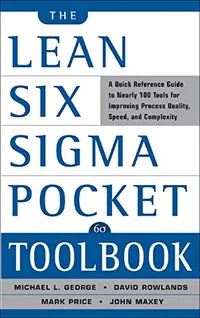
By Michael L. George, Dave Rowlands, Mark Price, John Maxey · 240 pages · First published 2004, still in print · Verdict: the working Belt's desk reference. Every certified practitioner owns one within their first year.
This is the book you do not read so much as consult. Hundred-plus LSS tools, each in a 1-3 page card format — problem definition, DMAIC tools, lean tools, statistical tools, project management. When a team meeting goes "wait, how does an X-bar chart actually work again?", this is the book that opens on the conference-room table within thirty seconds. It is the #1 best-seller in the Six Sigma niche on Amazon and has been for over a decade. There is a reason: it is genuinely good at the job it was designed for.
Where it earns its place: primary desk reference. Buy it before any other book on this list if you do project work weekly. The format does not reward reading cover-to-cover; the index and table of contents do all the work.
Honest weakness: if you have never run a Six Sigma project, the Pocket Toolbook will not teach you how to run one. The tool cards assume you already know which tool to pick and when. Pair it with #3 (George's full Lean Six Sigma) or #4 (The Six Sigma Way) for the methodological scaffolding around the tools.
2. Lean Six Sigma Green Belt Certification Study Guide 2026-2027
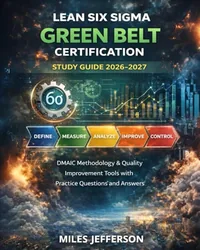
By Miles Jefferson · ~350 pages · Edition: 2026-2027 (released Feb 2026) · Verdict: current to ASQ exam updates. The right pick for active certification candidates this year.
If you are sitting an ASQ or IASSC Green Belt exam in 2026 or 2027, this is the version of the study guide to use. Exam content evolves — the 2026 update covers the recent expansion of Voice of Customer methods, refreshed control-chart conventions, and a re-weighted Improve phase. Older study guides (2022, 2020) still teach the right material but miss the proportional emphasis the current exam puts on certain sections.
Where it earns its place: the only book on this list designed specifically for exam pass rate. Practice questions are exam-shaped, not academic exercises. The chapter sequencing matches the ASQ Body of Knowledge order.
Honest weakness: a study guide is not a practitioner's manual. After you pass the exam, this book sits on the shelf. That is fine — it has done its job. Do not expect to use it after certification the way you will use the Pocket Toolbook or the Toyota Way.
3. Lean Six Sigma: Combining Six Sigma Quality with Lean Production Speed

By Michael L. George · 368 pages · First edition 2002, still the canonical full-method text · Verdict: the deployment leader's book. Read before you launch an LSS program at a new site.
George founded the consulting firm that became Accenture's LSS practice. This is his methodological flagship and the book that mainstreamed the integration of Lean and Six Sigma into one method. It walks the full DMAIC cycle with substantial examples and explains why the speed-plus-quality combination produces results neither approach delivers alone. Long-form prose, not bullet-point cards — this is the book to read cover-to-cover.
Where it earns its place: deployment context. If you are responsible for rolling LSS into an organisation that has not used it before, this is the framing book. Leadership reads it and gets the strategic argument; project leaders read it and get the operational map.
Honest weakness: at 24 years old, some operational examples date themselves. The thinking has aged well; some of the case studies have not. Skim the case studies, read the methodology chapters closely.
4. The Six Sigma Way
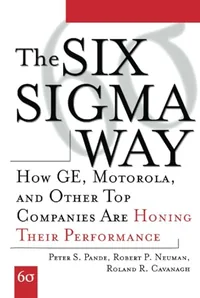
By Peter S. Pande, Robert P. Neuman, Roland R. Cavanagh · 448 pages · Updated 2014, still actively referenced · Verdict: the manager-friendly entry. Named by TIME among the 25 most influential management books.
What Pande and co-authors did well was write Six Sigma for a manager without an engineering background. The book opens with the deployment strategy, not with the statistics. Belt training, project selection, executive sponsorship, and change management get more pages than control charts — which is the right emphasis for the audience. The statistical content is present but accessible.
Where it earns its place: the book to hand a sceptical executive sponsor. Reads as business strategy with method underneath. Particularly useful in service-industry and healthcare LSS contexts where the manufacturing examples in George's book feel further removed.
Honest weakness: not enough Lean. The title is honest — this is Six Sigma first, Lean second. If your deployment leans Lean (pun unavoidable), pair with #5 (Toyota Way) or #7 (Lean Thinking) for balance.
5. The Toyota Way (2nd Edition)
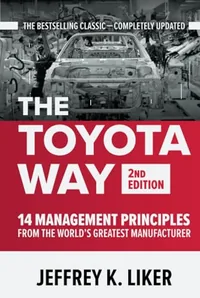
By Jeffrey K. Liker · 448 pages · 2nd edition published 2021 · Verdict: Lean's source text. Every certified Belt eventually re-reads this.
Liker is a University of Michigan professor who spent decades inside Toyota's culture and methods. The 14 Toyota Production System principles he formalised in the first edition (2004) are now the de facto Lean management framework taught everywhere. The 2nd edition (2021) adds chapters on innovation, software development applications, and how TPS principles translated to non-manufacturing contexts — the additions are useful but the core is unchanged from the original.
Where it earns its place: Lean foundations. Every Belt who only reads tactical books eventually hits a project where the answer is cultural, not procedural. This is the book that has the cultural answer. Re-read it every 3-4 years — you find different things on each pass as your experience builds.
Honest weakness: long. 448 pages of Toyota framing is more than most readers need on first contact. If you want the compressed version, John Shook's Managing to Learn (~140 pages) covers similar ground specifically through the A3 lens.
6. Toyota Kata
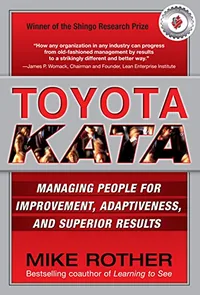
By Mike Rother · 336 pages · Published 2009, still the canonical text on improvement kata · Verdict: the book that reframes improvement as daily habit, not project.
Rother's contribution to Lean is naming the difference between improvement projects and improvement routines. Projects start, end, and produce a report. Routines (the "kata" of the title, borrowed from martial-arts practice) are daily disciplines that develop the capability to improve continuously. The book lays out the Improvement Kata and the Coaching Kata as two paired routines that produce a learning organisation over years.
Where it earns its place: the missing piece in most LSS deployments. Belt training teaches projects; this book teaches what happens between projects. If your organisation finishes LSS projects but does not get continuously better, this is the book that explains why.
Honest weakness: abstract in places. Rother is academically rigorous — the kata diagrams require patience. The first chapter is the densest; once you cross that, the rest moves faster.
7. Lean Thinking
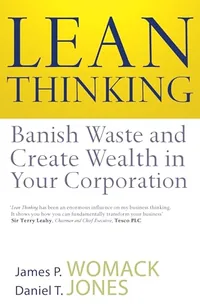
By James P. Womack, Daniel T. Jones · 396 pages · Revised 2003 edition still in print · Verdict: the book that named "lean" in business vocabulary. Foundational, not tactical.
Womack and Jones did not invent Lean — Toyota did. What they did was name it, popularise it, and frame the five principles (value, value stream, flow, pull, perfection) that every Lean training program now teaches in week one. The book uses five case studies from companies across continents to demonstrate the principles in action. It is the lineage text, not the tactical playbook.
Where it earns its place: conceptual scaffolding. If you keep hearing "value-stream mapping" and "pull system" and want to know where those terms come from and why they matter, this is the source. Pair with #5 (Toyota Way) for the full Lean foundation.
Honest weakness: case studies are 1990s. The principles transfer; the specific company examples are dated. Read for the framework, skim the cases.
8. The Goal (40th Anniversary Edition)
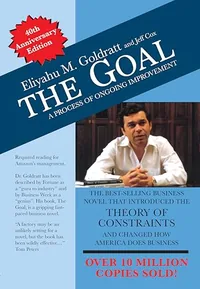
By Eliyahu M. Goldratt & Jeff Cox · 384 pages · 40th anniversary edition released 2024 · Verdict: the most-read book in this niche. 7M+ copies. There is a reason.
The Goal is the business novel about a plant manager named Alex Rogo who has 90 days to save his factory and learns to think in constraints along the way. Goldratt's Theory of Constraints is the through-line: improve the bottleneck, not the rest. It is the only book on this list you can read on a five-hour flight cover-to-cover and arrive with a different mental model of process improvement.
Where it earns its place: the gateway. The Goal is the book you give to colleagues who do not yet see why this thinking matters. It teaches constraints, throughput, and the discipline of working on the right thing without ever using a textbook tone. 8,000+ Amazon reviews is unusual in this niche — the reach is the point.
Honest weakness: not actually a Lean Six Sigma book. Theory of Constraints overlaps with Lean but is its own school of thought. Reading The Goal does not prepare you for a Green Belt exam. Reading it does change how you frame problems before any LSS analysis starts — which is more valuable in practice.
9. Beyond the Five Whys
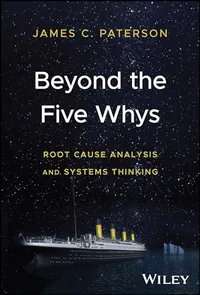
By James C. Paterson · 272 pages · Published 2024 (latest edition) · Verdict: the only book dedicated to extending 5 Whys with systems thinking. Niche but precise.
Most LSS books treat 5 Whys as a 15-minute root cause tool. Paterson treats it as the seed of systems thinking and develops it into a multi-causal investigative framework with verification, evidence chains, and feedback loops. He is honest about where standalone 5 Whys breaks down — person-blame termination, single-chain bias, opinion masquerading as cause — and offers the moves to push past those limits.
Where it earns its place: the only serious extended treatment of 5 Whys in print. If you facilitate 5 Whys sessions as part of your work, this book moves your practice forward. Paired with facilitation discipline, it is the difference between teams that find symptoms and teams that find systemic causes.
Honest weakness: niche. If you do not run 5 Whys regularly, the book will read as overkill. Most general LSS practitioners are better served by chapters in #1 (Pocket Toolbook) or #3 (George) than by reading Paterson cover-to-cover.
10. The Phoenix Project
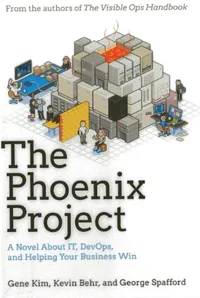
By Gene Kim, Kevin Behr, George Spafford · 432 pages · 5th anniversary edition (2018) still current · Verdict: The Goal for IT and DevOps. Modern context that Lean Six Sigma practitioners often miss.
The Phoenix Project is consciously modelled on The Goal — same business-novel format, different industry. Bill Palmer inherits a failing IT operation with 90 days to save the company. He learns from a mysterious mentor figure (Erik, the modern Jonah) that IT work is constrained by the same flow, batch-size, and bottleneck dynamics as the manufacturing plant in Goldratt's original. The three ways — flow, feedback, continuous learning — map cleanly onto Lean thinking.
Where it earns its place: bridges Lean Six Sigma into modern IT and software contexts. Most LSS practitioners who came from manufacturing have not read this; most DevOps practitioners who have read this do not know it is Lean. If you are working at the seam — quality, reliability, SRE, platform engineering — this is the translation layer.
Honest weakness: not for pure manufacturing audiences. The IT setting alienates some LSS readers who do not see the analogy. If your work is exclusively physical-process LSS, skip this one and re-read The Goal instead.
Honourable mentions
Five books that did not make the top 10 but earn shelf space in specific contexts:
- Managing to Learn by John Shook — the compressed Toyota Way through the A3 lens. ~140 pages. If you want the foundation without the 448-page commitment, start here.
- Learning to See by Mike Rother & John Shook — the value-stream-mapping workbook. Shingo Prize winner. The right book if VSM is a near-term project.
- Out of the Crisis by W. Edwards Deming — the source for PDCA and statistical quality control. Reads as 1980s manufacturing critique but the principles are foundational.
- The Machine That Changed the World by Womack, Jones, Roos — the 1990 MIT study that introduced Lean to Western audiences. Historical context, not tactical.
- Lean Six Sigma for Service by Michael L. George — the service-industry application of George's flagship method. The right pick if your work is healthcare, banking, or call-centre operations.
How to pick the right one for where you are
| If you are... | Start with | Then read |
|---|---|---|
| Sitting Green Belt this year | #2 Jefferson study guide | #1 Pocket Toolbook (desk ref); #5 Toyota Way (foundations) |
| Leading an LSS deployment | #3 George's Lean Six Sigma | #4 The Six Sigma Way (manager framing); #6 Toyota Kata (sustainability) |
| Already certified, want to deepen | #5 Toyota Way + #6 Toyota Kata | #9 Beyond the Five Whys; #7 Lean Thinking for lineage |
| Convincing an exec sponsor | #8 The Goal | #4 The Six Sigma Way; #10 Phoenix Project if IT |
| Working in IT / DevOps / SRE | #10 The Phoenix Project | #8 The Goal (the original); #1 Pocket Toolbook for tools |
| Have five hours total | #8 The Goal (one flight) | #1 Pocket Toolbook as a desk reference for everything else |
What this list is not
This is not a Black Belt reading list. Black Belt-level statistical depth lives in different books — Pyzdek's Quality Engineering Handbook, Barsalou's Statistics for Six Sigma Black Belts, Montgomery's Introduction to Statistical Quality Control. Most Green Belts and most LSS practitioners working day-to-day on improvement projects do not need that depth. If you do, the Black Belt list is a separate piece in production.
This is also not a healthcare-specific list, an Agile-specific list, or a software-reliability list. Each of those niches has its own canon — the broader RCA books page covers titles across those adjacent fields. If your primary frame is "Lean Six Sigma" in the canonical sense (manufacturing, operations, services, with DMAIC as the spine), the ten above are the picks. If your primary frame is something narrower, that page is the better starting point.
While you wait for the books to ship
Most of these books teach methods you can practice today. The 5 Whys tool runs in your browser — same logic, different medium. The Fishbone tool maps the cause landscape Paterson and the Pocket Toolbook both reference. Run a small problem through them this week and the books land harder when they arrive.
Open the 5 Whys tool →Frequently asked questions
Which Lean Six Sigma book should I read first?
If you are studying for the Green Belt exam, start with the Jefferson 2026-2027 study guide because it is current to ASQ exam updates. If you are leading an LSS deployment without certification pressure, start with Michael George's Lean Six Sigma for the full method. If you have less than five hours total reading time and need a working reference, buy The Lean Six Sigma Pocket Toolbook and skim the table of contents — it is the field-reference that every certified Belt keeps within arm's reach.
Are the older Lean Six Sigma classics still worth reading in 2026?
Yes for the foundations, no for the tactics. The Toyota Way, Lean Thinking, and The Goal are still the clearest explanations of what Lean is and why constraint theory matters — that thinking does not age. But for tactical Six Sigma execution (control charts, DOE, Minitab workflow), use editions from 2020 onward because ASQ exam content updates and statistical software UIs have moved on. Pair an older classic for thinking with a current title for execution.
Do I need both a Lean book and a Six Sigma book?
In 2026, no. Lean Six Sigma has been treated as one integrated method for two decades. The certification bodies (ASQ, IASSC) test both as one combined body of knowledge. The books on this list that use "Lean Six Sigma" in the title cover both. Reading separate Lean-only and Six Sigma-only texts is mostly a historical preference now — only worth doing if you want to understand the lineage of each before they merged.
How does this list differ from your broader RCA books page?
The broader root cause analysis books page covers 23 titles across five categories: Lean foundations, Six Sigma, RCA-specific, Agile/DevOps, and systems thinking. This list is tighter — ten books specifically for someone whose primary frame is Lean Six Sigma (certification, deployment, daily practice). If you are coming from healthcare quality, SRE, or pure RCA work, the broader page is a better starting point. If your work is LSS specifically, start here.
Can I really learn Lean Six Sigma from books alone?
You can learn the vocabulary, the tool set, and the structure of DMAIC entirely from books — and pass a Green Belt exam on book study plus practice questions. What you cannot get from books is the experience of facilitating an angry cross-functional team through D4 root cause when half of them disagree. That comes from running real projects under a coach. Use the books as your textbook layer; pair them with a mentored project for the rest.
What about Black Belt-level books?
Black Belt material starts where this list ends. For statistical depth at Black Belt level, the canonical references are Statistics for Six Sigma Black Belts by Matthew Barsalou and Quality Engineering Handbook by Thomas Pyzdek. Both are dense, exam-oriented, and assume Green Belt fluency. We have a separate page in the pipeline for Black Belt and Master Black Belt reading — most practitioners do not need that depth until they are leading multi-site deployments.
Related resources
- Best books on root cause analysis — 23 picks — the broader sibling of this page, covering RCA across five categories beyond LSS
- Root cause analysis — the complete guide — method overview before you pick a textbook
- A3 vs 8D vs DMAIC vs 5 Whys — framework comparison to figure out which Belt-level method fits your problem
- 5 Whys complete library — deep dive on the technique Paterson extends in #9
- A3 problem solving guide — the canvas behind Liker's Toyota Way and Rother's improvement kata
- The PDCA cycle — the foundation Deming codified, which every LSS book on this list eventually returns to
- How to facilitate an RCA workshop — the meeting discipline the books assume you already have